

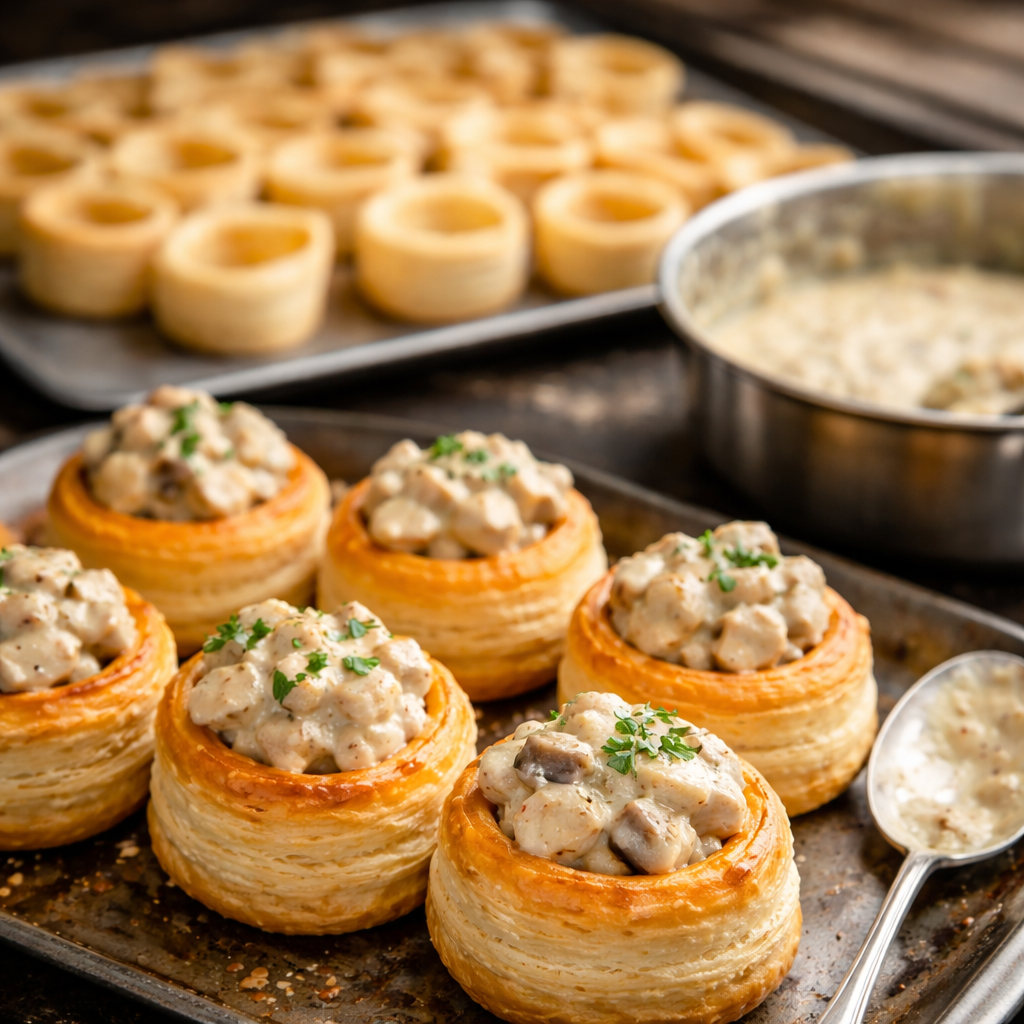
26 Mar Bulk-Prepared Chicken and Mushroom Vol-au-Vents
Vol-au-vents have been on catering menus for decades, and for good reason. They are forgiving to produce in volume, elegant enough for formal service, and genuinely enjoyed by guests across dining contexts from hotel buffets to corporate cocktail functions. The challenge most kitchen teams face is not the recipe itself but the production system behind it. Getting vol-au-vents right at scale, consistently, across a busy week of events, requires a different approach to how you think about prep, holding, and assembly.
This article breaks down the production logic for bulk-prepared chicken and mushroom vol-au-vents, covering ingredient selection, batch prep workflow, filling ratios, freezing protocols, and the quality controls that separate a polished catering output from a mediocre one.
Why Vol-au-Vents Still Work at Scale
There is a reason vol-au-vents have survived every trend cycle in professional catering. The pastry case acts as a self-contained vessel that holds filling without leaking, travels well on trays, requires no plating skill from service staff, and delivers a consistent visual. For high-throughput operations, that combination is difficult to beat.
The challenge is that puff pastry is unforgiving if your production system is not tight. Soggy bases, collapsed cases, or filling that has been held too long all signal poor prep discipline rather than a problem with the dish. The fix is almost always in the workflow, not the recipe.
Ingredient Selection for High-Volume Production
Puff Pastry
Ready-rolled puff pastry sheets are the only practical choice for catering quantities. Laminated block pastry is too time-intensive to process at volume and inconsistent in thickness without a sheeter. Look for sheets that are uniform in thickness, approximately 3mm pre-bake, and sourced from a supplier with consistent cold chain management. Pastry that has been partially thawed and refrozen during distribution will bubble unevenly and produce weak case walls.
For a batch of 200 cases, plan on approximately 6 to 8 kg of pastry sheet, depending on your cutter size. A 7cm round cutter with a 4cm inner ring is the industry standard for cocktail-portion vol-au-vents.
Chicken Breast
Bulk chicken breast is the protein of choice for vol-au-vent filling for two reasons. It has a neutral flavour that carries the sauce without competing with it, and it holds texture through the cook-chill-reheat cycle better than thigh meat, which can become stringy. Sourcing chicken breast from a reputable bulk food supplier [LINK: bulk food suppliers south africa] with cold chain integrity is non-negotiable. Protein that has experienced any temperature abuse during distribution will break down during the secondary cook in the sauce and produce a filling with poor texture and shortened shelf life.
Dice chicken breast into 1.5cm cubes before cooking. Larger pieces create an uneven fill and make it difficult to portion with a spoon during service assembly.
Mushrooms and Aromatics
Button mushrooms are the standard choice for volume production, but a blend of button and portobello at a 3:1 ratio adds depth without significantly increasing cost. Slice mushrooms to approximately 5mm. Thinner slices will dissolve into the sauce during the cook; thicker slices create textural inconsistency in the finished filling.
Aromatics should be limited to shallots, garlic, and fresh thyme. Over-seasoning the filling at the production stage is a common error. The flavour concentrates when the filling is held and reheated, so season conservatively during prep and adjust only at the final reheat stage.
Filling Ratios and Sauce Construction
The sauce is where most bulk vol-au-vent productions fail. A velouté base made from a dry goods roux and quality chicken stock is the correct approach for catering quantities. Cream-based sauces break down faster during holding and do not freeze as cleanly as a velouté.
For every 5 litres of finished filling, use the following ratios as your starting point:
- 1.5 kg diced chicken breast, poached and cooled
- 600 g sliced mushrooms, sweated in butter
- 300 g plain flour and 300 g butter for the roux base
- 3 litres of hot chicken stock
- 150 g finely diced shallots, softened
- 2 cloves garlic, minced
- Fresh thyme, white pepper, and salt to finish
The filling should be thick enough to hold its shape when spooned but fluid enough to settle into the pastry case. If the velouté is too tight, it will crack when chilled. If it is too loose, it will make the pastry base soggy within minutes of assembly.
Batch Baking and Case Production
Baking the Cases
Bake pastry cases at 200 degrees Celsius on lined flat trays. Do not overload the tray. Cases need space around them for even heat circulation. A common error in high-volume baking is crowding the tray to save oven time, which produces uneven rise and pale sides.
Bake time is 14 to 16 minutes, depending on your oven. Cases should be deep golden brown. Underbaked cases absorb filling moisture rapidly and become soft within the hour. Remove the inner pastry lid from each case while still warm and set aside for replacement before service.
Holding Baked Cases
Baked cases can be held in airtight containers at room temperature for up to 48 hours before filling. For longer production windows, freeze unfilled cases in single layers separated by parchment. Reheat from frozen at 180 degrees Celsius for 6 minutes before filling and serving.
Assembly and Service Protocols
Never fill vol-au-vents more than 30 minutes before service. The pastry will begin absorbing moisture from the filling immediately. For a formal buffet, fill to order from chafing pans where the filling is held at 75 degrees Celsius or above.
For cocktail functions where canapés must be pre-assembled on trays, work in batches of 30 to 40 pieces at a time, filling just ahead of tray dispatch to service. Replace the pastry lid after filling and finish with a small sprig of thyme if the event format calls for garnishing.
Freezing for Future Events
Filled vol-au-vents can be frozen successfully if the filling has been made with a velouté base. Cream-based fillings will split on thawing. Arrange filled cases on flat trays and blast-chill to below -18 degrees Celsius before transferring to sealed containers. Label with date, batch number, and filling weight.
To reheat from frozen, place cases on a rack over a flat tray at 175 degrees Celsius for 12 to 14 minutes. The rack prevents the base from steaming and softening on contact with the tray. Internal temperature must reach 75 degrees Celsius before service. A well-managed vol-au-vent production batch can be frozen for up to 6 weeks without quality loss.
Sourcing at Scale
The quality of a vol-au-vent at a function of 300 guests is determined long before the oven is turned on. It starts with the consistency of your puff pastry sheets, the condition of your bulk chicken breast on delivery, and the quality of the plain flour and butter that form your roux. These are commodity ingredients that vary significantly between suppliers, and that variation shows up in the finished product.
Oil and More supplies bulk dry goods and pantry essentials, including plain flour, butter, and cooking oils to hospitality operations across Cape Town, with cold chain delivery capability for protein and dairy requirements. Their products and services range and cover the full category spread needed for a production kitchen running prep-intensive catering items at volume. Contact Oil and More to discuss supply volumes and delivery schedules.
Frequently Asked Questions
How far in advance can I prepare vol-au-vent filling?
Filling made with a velouté base can be refrigerated for up to 72 hours. Cool rapidly after cooking, store in shallow containers to encourage even chilling, and reheat to 75 degrees Celsius minimum before use. Do not hold filling at temperatures between 5 and 60 degrees Celsius for longer than 2 hours in total across its entire use life.
Can I use frozen puff pastry sheets for catering quantities?
Yes, and for most catering operations, it is the correct choice. The key is thawing under refrigeration rather than at room temperature. Pastry thawed at ambient temperature develops condensation on the surface, which causes uneven rise and weak case walls. Thaw overnight in the refrigerator and cut and bake directly from the chilled.
What is the best way to keep vol-au-vents crisp at a buffet?
The single most effective method is to fill them as close to service as possible and hold the filling separately in a heated insert. If the function format requires pre-assembled trays, brush the inside of each baked case lightly with melted butter before filling. Both create a moisture barrier that extends the window before the base softens.
How many vol-au-vents should I plan per head for a cocktail function?
For a cocktail event with a mixed canapé spread, plan 3 to 4 pieces per person per canapé variety over a 90-minute service window. If vol-au-vents are the primary substantial canapé, increase to 5 to 6 per person. Always prepare 10 percent above your confirmed guest count to cover breakage during baking and service.
What fillings work alongside chicken and mushrooms for a varied canapé menu?
Creamed spinach and feta, prawn and dill velouté, and smoked salmon with cream cheese are the three most reliable alternatives for upmarket functions. All three can be made using a similar production method and held or frozen using the same protocols as the chicken and mushroom variation.
No Comments