

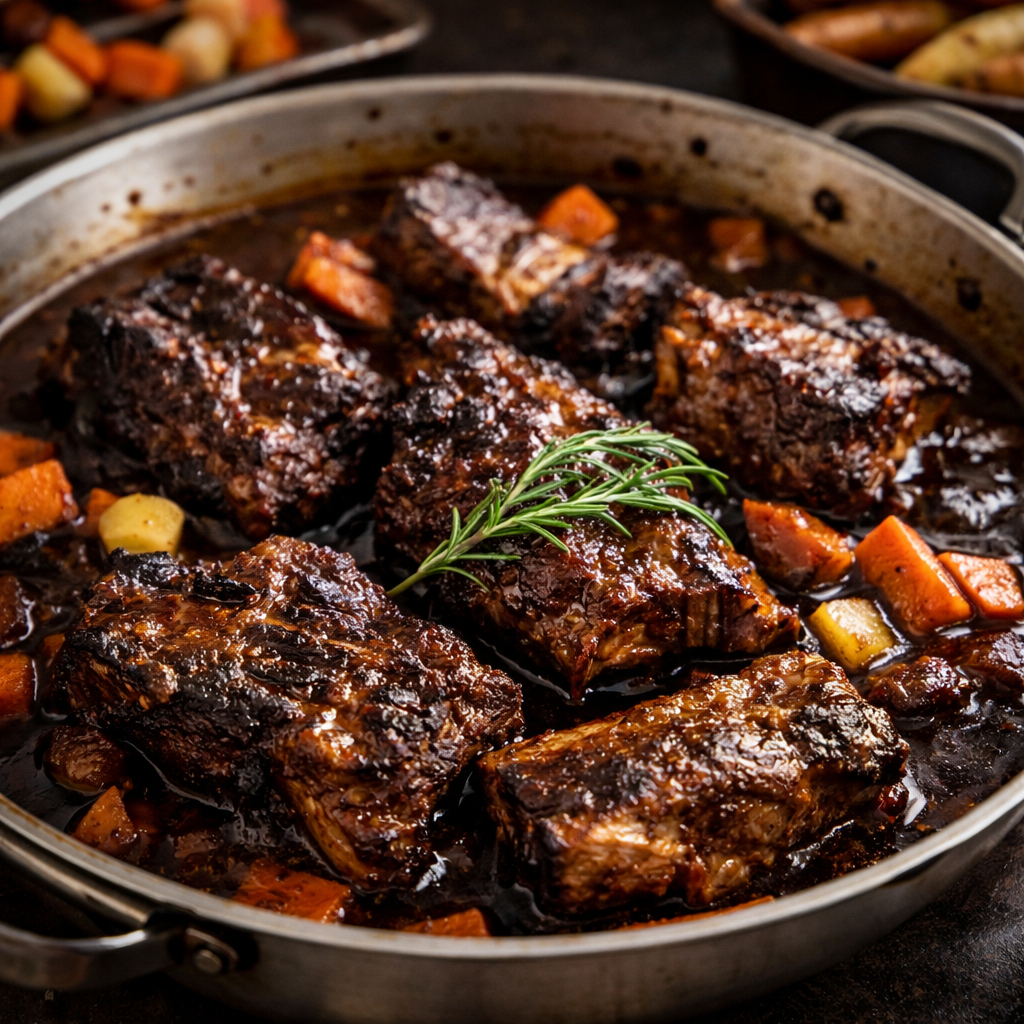
26 Mar Winter Menu Prep: Slow-Braised Short Rib with Root Vegetables
There is a reason braised short rib appears on the winter menu of virtually every serious restaurant and hotel in South Africa. It is a dish that delivers on every level that matters during the cold months: deeply satisfying, holds and reheats without quality loss, photographs well, and gives the kitchen a protein that rewards time rather than demanding precision timing at the pass.
The problem most kitchens run into is not the recipe. It is the production system. Short rib at catering volume requires thinking about the braise differently, from how you handle your bulk protein on delivery through to how you portion, hold, and present at service. Get those decisions right, and short rib becomes one of the most reliable, cost-efficient dishes in your winter rotation.
Selecting the Right Short Rib Cut
There are two primary cuts in the short rib family, and the distinction matters for catering production. English-cut short ribs are cut across a single rib bone, producing a thick slab of meat on the bone, ideal for plated restaurant service and individual portion control. Flanken-cut ribs are cut across multiple bones, producing thinner strips better suited to Korean-style grilling.
For South African catering and hotel kitchen use, English-cut short rib is the standard. Specify bone-in cuts at 300 to 350g raw weight per portion. The bone contributes collagen to the braise and helps the meat retain its shape during long cooking. Inspect on delivery: marbled fat should be white, the meat should be bright cherry red, and there should be no off aroma.
The Braise: What Is Actually Happening
Understanding the science behind a braise helps you make better decisions at scale. Short rib is high in collagen, particularly in the intercostal muscle tissue between the ribs. When held at temperatures between 70 and 90 degrees Celsius over several hours, that collagen converts to gelatin, which is what gives a well-executed braise its unctuous, glossy texture and lip-coating mouthfeel.
The critical insight for catering production is that the conversion is time and temperature-dependent. Too high a heat and you denature the protein before the collagen has time to convert, producing dry, fibrous meat in a thin sauce. Too low and the process stalls. The target is a steady 80 to 85 degrees Celsius throughout the braise, maintained consistently for a minimum of 4 hours for English-cut short rib at catering sizing.
A combination oven on a low steam-injection programme, or a covered roasting pan in a deck oven at 150 degrees Celsius, is reliable for catering quantities. Tilting braising pans can be used but require careful temperature monitoring as they tend to run hotter at the base.
Building the Braise Liquid
The Stock Base
The quality of your braise liquid directly determines the quality of your finished sauce. A well-made beef stock, reduced to a demi-glace concentration, produces a sauce that is naturally glossy and deeply flavoured without requiring heavy reduction at the end. For every 10 portions, prepare 2 litres of braise liquid at the following ratios:
- 1.2 litres of beef stock at demi-glace concentration
- 400ml red wine, reduced by half before adding
- 200ml crushed tinned tomato
- 1 head of garlic, halved horizontally
- Fresh thyme, bay, and rosemary bundle
- Black peppercorns and salt
Root Vegetables
For a winter menu, the root vegetable component serves two purposes: it contributes flavour to the braise liquid during cooking and provides the garnish component on the plate. Use a mix of carrot, parsnip, and turnip cut to 40mm batons. Add them to the braise for the final 45 minutes of cooking rather than from the start. Early addition produces vegetables that are overcooked and grey by the time the rib is ready. Celeriac, where available, makes an excellent addition and signals seasonal intent to a discerning guest.
Searing at Volume
Searing short rib before braising is non-negotiable even at catering scale. The Maillard reaction on the surface of the meat produces flavour compounds that do not develop during the wet braise and cannot be added back afterwards. A short rib that has been seared correctly has a different flavour depth to one that went into the braise pale.
Season your rib portions generously with salt and black pepper at least 2 hours before searing, or ideally overnight. Pat dry before they go into the pan. Sear in batches in a cast iron pan or flat griddle at the highest practical heat, 30 to 45 seconds per face for colour rather than cooking. Do not crowd the pan. Crowded searing drops the pan temperature and produces steaming rather than browning.
Portioning, Holding, and Service
After the Braise
Remove the ribs from the braise liquid and allow to cool on a rack. Once cool enough to handle, check each portion: the meat should pull slightly from the bone but hold its structural integrity. If any portions have broken apart, reserve them for a separate service application such as a short rib hash or a pasta sauce.
Strain the braise liquid and reduce to a sauce consistency. For every 500ml of strained liquid, reduce to approximately 150ml for a sauce that coats the back of a spoon. Season carefully. The sauce will be intensely flavoured and needs minimal addition.
Holding for Service
Store portioned ribs in the reduced sauce in hotel pans. This prevents them from drying out during holding and keeps the surface glazed and presentable. Hold at 65 degrees Celsius minimum. For a buffet format, check the sauce consistency during service and add small amounts of warm stock to maintain it. Short rib held correctly in sauce will maintain quality for up to 4 hours at service temperature without degradation.
Plating and Presentation at Volume
For plated service, one bone-in portion centred on a smear of celery root puree or creamy mashed potato, the root vegetables arranged alongside, and the sauce spooned over at the pass. A small amount of fresh horseradish grated over the top at service adds a sharp aromatic contrast that lifts the dish.
For buffet service, present in a wide, shallow chafing pan with the sauce visible and the bone ends pointing upward. Label clearly. Guests are reassured by bone-in cuts because the visual signals slow cooking and quality.
Sourcing for Winter Menu Production
A short rib braise production schedule of any scale depends on a reliable supply of bone-in short rib with consistent sizing, quality root vegetables, and dry stock base. These are not areas where substitution mid-service is practical. Oil and More provides bulk protein and frozen goods alongside a range of dry pantry items for professional kitchen operations in Cape Town. Their food packaging and holding containers range covers the formats required for off-site transport of portioned short rib. Contact Oil and More to discuss supply terms and delivery lead times for your winter season requirements.
Frequently Asked Questions
How long in advance can I braise short ribs for an event?
Short rib can be braised up to 72 hours before service and held refrigerated in its sauce. The flavour improves significantly with a 24 to 48-hour rest. Reheat in a covered roasting pan at 160 degrees Celsius for 25 to 30 minutes, or in a steam oven at 80 degrees Celsius for 20 minutes. Ensure the internal temperature reaches 75 degrees Celsius before service.
How do I calculate raw weight to serving quantity?
Plan on a yield of approximately 55 to 60 percent from bone-in short rib after braising. A 350g raw portion produces approximately 190 to 210g of cooked meat on the bone, which is the correct portion size for a main course plate. For a buffet, reduce your raw weight calculation by a further 10 percent to account for yield at the serving point.
Can short ribs be frozen after braising?
Yes. Short rib freezes exceptionally well in its braising sauce. Cool rapidly, freeze at -18 degrees Celsius, and hold for up to 10 weeks. Thaw under refrigeration for 24 hours. The texture of properly frozen and thawed braised short rib is indistinguishable from freshly made in blind tastings.
What wine should be used in the braise for a large batch?
Use a dry, full-bodied red that you would drink but would not pay a premium for. Shiraz or Cabernet Sauvignon from a South African producer is the practical choice for cost management at catering scale. Reduce the wine separately before adding it to the braise liquid to cook off the alcohol. Never use cooking wine.
How do I prevent the sauce from being too salty after reduction?
Season the braise liquid lightly at the start and correct only after the sauce has reached its final consistency. A sauce that tastes correct at full volume will be oversalted after reduction. If you have oversalted a reduced sauce, add a small amount of unsalted stock and re-reduce rather than trying to mask the salt with sugar or acid.
No Comments