

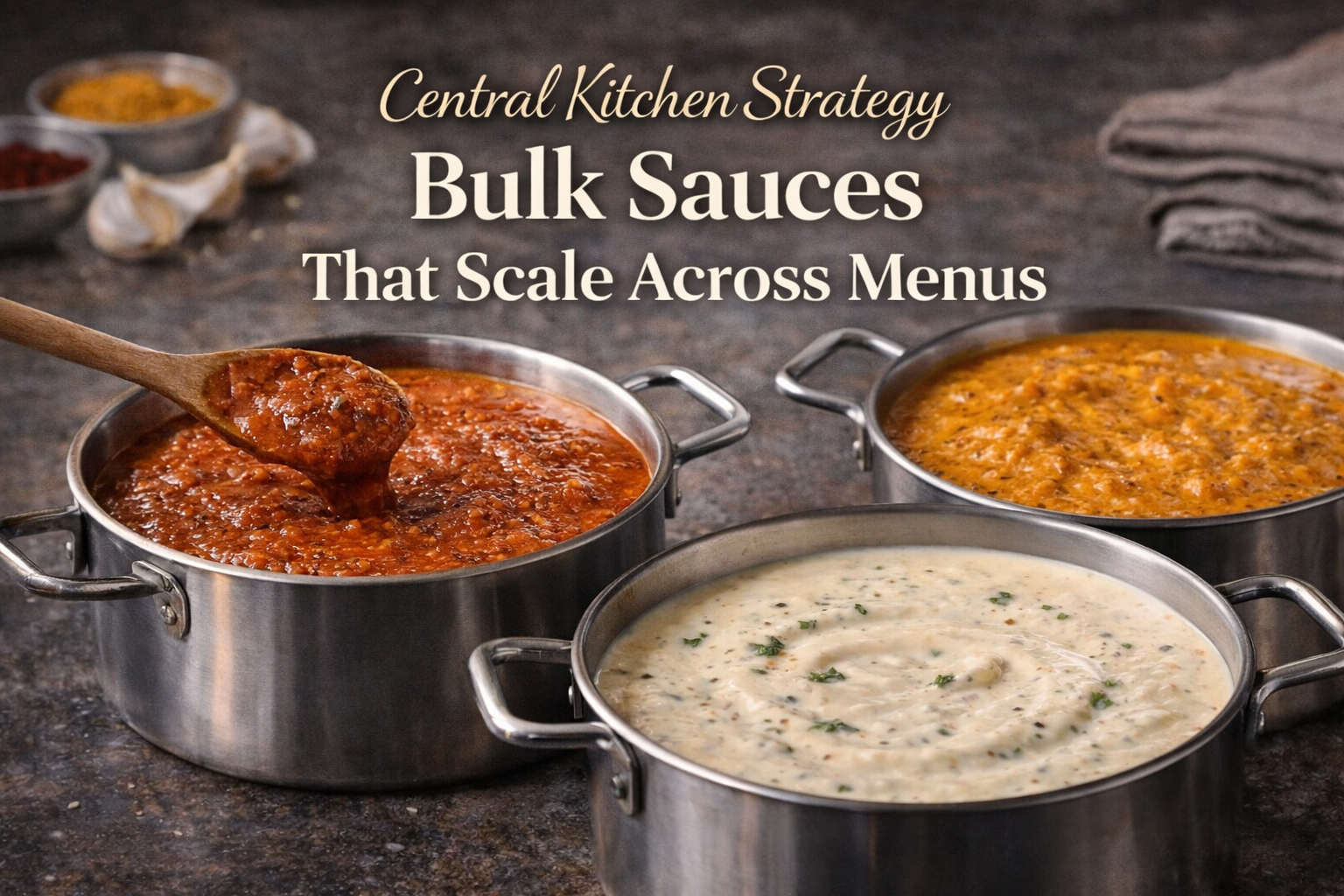
18 Apr Central Kitchen Strategy: Bulk Sauces That Scale Across Menus
In any busy food operation, consistency is what holds everything together. Guests expect the same flavour, texture, and quality whether they order a pasta on a Tuesday lunch service, a plated chicken dish at a catered function, or a staff meal built from surplus prep. For restaurant groups, production kitchens, and growing hospitality brands, that consistency becomes much easier to achieve when the operation is built around strong foundational systems.
That’s where bulk sauces come in.
A well-designed sauce programme gives a central kitchen the power to streamline prep, reduce duplication, control labour, and support multiple menu applications from one smart base. Instead of producing completely separate sauces for every dish, teams can build versatile tomato bases, cream bases, and flavour-building components using spices and oils, then adapt them across the menu with purpose.
This is one of the simplest ways to improve restaurant systems without making the food feel repetitive. In fact, when done properly, batch cooking can create more flexibility, not less. A strong base sauce becomes a foundation chefs can customise for different service styles, menu categories, and customer expectations.
Why Central Kitchens Rely on Base Sauces
Central kitchens are designed to create order at scale. Whether they support one flagship site or a network of restaurant locations, their role is usually the same. They reduce pressure on individual kitchens by moving high-volume prep, standardisation, and early-stage production into one controlled environment.
Base sauces fit naturally into that model because they offer three things every operation needs:
- consistency across dishes and locations
- speed during service
- more efficient use of labour and ingredients
Instead of having every branch or section make the same sauce from scratch, the central kitchen can produce a carefully balanced base in bulk, portion it accurately, and distribute it as part of a structured prep system.
That means less variability, fewer rushed shortcuts, and better cost control.
What Makes a Sauce Scalable Across Menus
Not every sauce is suited to central production. Some are too delicate, too narrow in application, or too dependent on last-minute finishing. A scalable sauce needs to be stable, adaptable, and worth making in volume.
In practical terms, that means it should:
- hold well in chilled storage
- reheat without splitting or losing body
- work across more than one dish category
- allow finishing variations at site level
- deliver consistent flavour from batch to batch
A truly useful sauce base should not feel finished too early. It should arrive at the branch or finishing kitchen with enough structure to save time, while still leaving room for the final dish identity.
That balance is what makes a central kitchen system effective.
The Power of a Tomato Base
A tomato base is one of the most valuable components in batch cooking. It is broad enough to support multiple cuisines and familiar enough to fit across casual dining, catering, takeaway, and restaurant menus.
At its core, a strong tomato base usually includes tomatoes or tomato pulp, onion, garlic, seasoning, oil, and selected spices. The exact style depends on the brand and menu direction, but the goal remains the same. Build a rich, balanced base that can move easily into other dishes.
Once produced in bulk, a tomato base can be adapted into:
- pasta sauces
- pizza sauce finishes
- braising sauces
- shakshuka-style dishes
- tomato-based soups
- stew or casserole foundations
- baked dish sauces
- spiced condiment-style applications
This is where central kitchen thinking becomes powerful. One tomato base can lead to several menu outcomes with relatively small finishing changes.
For example, a classic tomato base might become a pasta sauce with herbs and butter, a braising liquid with stock and spices, or a soup base with roasted vegetables and cream. The labour-heavy part happens once. The variation happens later.
How a Cream Base Supports Multiple Menu Styles
A cream base plays a different role, but it can be just as useful in a central production model. When built properly, it becomes a backbone for rich sauces, pie fillings, pasta finishes, gratin components, and certain soup applications.
The key is building it for flexibility.
A central kitchen cream base often starts with fat, flour or another thickening system, dairy, seasoning, and a restrained aromatic profile. It should be smooth, stable, and neutral enough to adapt without tasting generic.
From there, it can be developed into:
- mushroom sauce
- pepper sauce
- cheese sauce
- creamy chicken pie filling base
- pasta sauce
- baked vegetable sauce
- chowder or creamy soup base
- gratin sauce
For operations using restaurant systems across several outlets, this kind of base reduces repeated prep at branch level and improves portion consistency.
It also allows chefs to control richness more accurately. Instead of each location making its own version with different seasoning or thickness, the central kitchen provides a dependable starting point.
Why Spices and Oils Matter More Than People Think
Sauce systems are not only about the major ingredients. Spices and oils often do the quiet work that makes a base taste complete.
In central production, they are especially important because they help create consistency without overcomplicating the recipe. Used correctly, they also make one base feel like many different dishes.
Spices can shape direction in a subtle but useful way. Paprika, cumin, coriander, black pepper, chilli, nutmeg, cinnamon, curry blends, and herb mixes all help shift a base from one menu application to another.
Oils do more than carry flavour. They influence aroma, mouthfeel, cooking performance, and finishing quality. Olive oil, neutral cooking oils, chilli oils, garlic oils, and herb-infused oils can all support different versions of the same core sauce.
This is why smart central kitchens often build flavour in layers. The mother sauce stays balanced and versatile. The final spice or oil profile gets adjusted closer to service, depending on the dish.
A Practical Central Kitchen Sauce Framework
The most effective systems are usually the simplest. A central kitchen does not need dozens of complex mother sauces to improve operations. It needs a few dependable bases with clear applications.
A practical starting framework could include:
1. Tomato base
Best for pasta, braising, baked dishes, soups, and stews.
2. Cream base
Best for pies, pasta, gratins, creamy soups, and rich plated dishes.
3. Brown or savoury stock reduction base
Best for gravies, meat finishes, braised dishes, and event-style mains.
4. Herb or oil-based flavour finish
Best for lifting dishes quickly without requiring full sauce prep from scratch.
Even if the operation begins with only tomato and cream bases, that can still remove a surprising amount of duplication from the kitchen.
How Batch Cooking Reduces Pressure in Service
Service speed is often where sauce systems prove their value. When the heavy lifting has already happened in the central kitchen, site-level teams can focus on cooking, finishing, and plating rather than building sauces from zero during a busy shift.
This helps in several ways:
- faster ticket times
- less pressure on skilled labour during service
- fewer mistakes from rushed sauce prep
- more reliable portioning
- easier training for newer kitchen staff
For multi-site restaurant systems, this matters even more. Not every branch will have the same staffing strength or prep capacity. A central kitchen helps level that out by sending each site a controlled, ready-to-use component that supports quality even in high-pressure conditions.
The Cost Benefits of Bulk Sauce Production
There is an operational reason sauce systems are so widely used, but there is also a financial reason. Bulk sauce production usually makes better use of labour, ingredients, energy, and storage.
The savings often show up in these areas:
- reduced duplicate prep across locations
- better yield from bulk ingredient purchasing
- improved stock rotation and ingredient planning
- lower waste from partial recipe batches
- more accurate portion control
Tomato products, cream base ingredients, spices, and oils are all easier to manage when purchased and used within a structured batch cooking system. Instead of multiple sites buying and preparing small inconsistent quantities, the central kitchen can standardise volumes and simplify forecasting.
That is one of the clearest ways to strengthen restaurant systems over time.
How to Keep Bulk Sauces from Feeling Repetitive
A common concern is that central kitchen sauces might make the menu feel too uniform. That only happens when the system is too rigid or the bases are over-finished.
The better approach is to keep the bulk sauce broad enough to support variation.
For example:
- a tomato base can become spicy, herbaceous, smoky, or richer depending on finishing
- a cream base can move toward mushroom, mustard, cheese, garlic, or pepper profiles
- oils can shift the final aroma quickly
- spice blends can change the personality of the dish without rebuilding the sauce
- fresh herbs, citrus, stock, butter, cream, and reductions can all tailor the final result
The goal is not to make every dish taste the same. The goal is to make every dish easier to produce consistently.
Storage, Portioning, and Food Safety Considerations
A sauce system only works if the logistics are sound. In central kitchen production, storage and portioning are just as important as flavour.
Bulk sauces should be:
- cooled quickly after production
- stored in clearly labelled containers
- dated for shelf-life tracking
- portioned into practical units for each site
- reheated according to food safety standards
The format matters too. Some kitchens do better with large foodservice tubs, while others need smaller measured pouches or containers for precise line use. The best format depends on the restaurant system, the delivery schedule, and how much finishing happens on site.
This is also where oils and spice kits can help. Sending a base sauce separately from finishing items allows branches to complete dishes with more freshness and flexibility.
Training Teams to Use the System Properly
Even the best sauce strategy can fail if teams do not understand how the bases are meant to be used. Clear communication is essential.
Each base should come with practical internal guidance such as:
- intended applications
- reheating method
- portion recommendations
- approved finishing variations
- shelf life and storage instructions
That kind of clarity improves consistency without stripping chefs of all discretion. It also makes training easier for new staff and supports smoother execution across different shifts and sites.
Common Mistakes to Avoid
A central sauce system should create flexibility, not frustration. A few mistakes can undermine that quickly.
Over-seasoning the base
If the sauce is too salty, too spicy, or too specific in flavour, it becomes harder to adapt across menus.
Making the base too finished
A mother sauce should leave room for final customisation. Locking in every detail too early reduces menu versatility.
Ignoring reheating performance
Some sauces taste good when fresh but lose texture after chilling and reheating. Test them under real conditions.
Using containers that do not match service needs
Poor portion formats create waste, slow down prep, and frustrate branch teams.
Failing to document the system
A scalable kitchen process needs written guidance. Verbal knowledge alone is not enough when teams grow.
FAQ
What is a central kitchen sauce system?
It is a production model where base sauces are made in bulk at a central facility, then distributed to support multiple dishes or locations.
Why are bulk sauces useful in restaurant systems?
They improve consistency, reduce duplicated prep, support batch cooking, and make service faster and more reliable.
What sauces work best for central kitchens?
Tomato bases, cream bases, stock-based savoury sauces, and oil-led flavour finishes are among the most useful because they adapt well across menus.
How do you stop bulk sauces from tasting repetitive?
Keep the base versatile, then adjust the final dish with spices, oils, herbs, dairy, stock, or other finishing ingredients.
Can batch cooking improve food cost control?
Yes. It often reduces labour waste, improves purchasing efficiency, supports portion control, and simplifies ingredient planning.
A Smarter Way to Build Menus at Scale
Bulk sauces that scale across menus are not just a prep shortcut. They are a strategy. For central kitchens, they create the structure needed to support consistency, speed, and smarter resource use across the business.
When tomato bases, cream bases, spices, and oils are used with intention, the result is not bland uniformity. It is a more organised, more adaptable kitchen system that gives chefs a solid foundation to work from.
For operators refining central kitchen processes, this is one of the clearest ways to simplify production without reducing menu quality. Strong restaurant systems are rarely built on flashy ideas alone. More often, they are built on dependable basics done exceptionally well.
No Comments